The Quick Answer
Sales Cloud is a CRM for sales teams. It helps manage leads, track opportunities, forecast revenue, and close deals.
Marketing Cloud is for marketing teams. It powers email campaigns, customer journeys, social media management, and advertising.
They serve different teams with different goals, but they work best when connected together.
What is Sales Cloud?
Sales Cloud Overview
Sales Cloud is Salesforce's flagship CRM product. It's designed to help sales teams manage the entire sales process from lead to closed deal.
Key Sales Cloud Features
- Lead Management — Capture, score, and route leads to the right sales reps
- Opportunity Tracking — Manage deals through stages with probability forecasting
- Account & Contact Management — 360-degree view of customers and companies
- Pipeline Management — Visual pipeline with forecasting and analytics
- Sales Automation — Workflows, approvals, and process automation
- Mobile App — Full CRM access on iOS and Android
- Einstein AI — Lead scoring, opportunity insights, and next best actions
Who Uses Sales Cloud?
Sales Cloud is used by sales development reps (SDRs), account executives, sales managers, and sales operations. It's the system of record for the sales organization.
What is Marketing Cloud?
Marketing Cloud Overview
Marketing Cloud is Salesforce's suite of marketing tools for cross-channel campaign management, customer journey orchestration, and marketing analytics.
Key Marketing Cloud Products
- Email Studio — Enterprise email marketing with personalization and automation
- Journey Builder — Visual customer journey orchestration across channels
- Mobile Studio — SMS, push notifications, and in-app messaging
- Advertising Studio — Audience targeting for Facebook, Google, and display
- Social Studio — Social media publishing, listening, and engagement
- Datorama — Marketing analytics and cross-channel reporting
- Interaction Studio — Real-time personalization and recommendations
Who Uses Marketing Cloud?
Marketing Cloud is used by email marketers, campaign managers, marketing operations, and demand generation teams. It's the execution engine for marketing programs.
Sales Cloud vs Marketing Cloud: Side-by-Side
| Aspect | Sales Cloud | Marketing Cloud |
|---|---|---|
| Primary User | Sales teams | Marketing teams |
| Main Purpose | Manage sales pipeline | Execute campaigns |
| Data Focus | Leads, contacts, opportunities | Subscribers, engagement, journeys |
| Key Metric | Revenue, win rate | Engagement, conversions |
| Platform | Core Salesforce platform | Separate platform (ExactTarget heritage) |
| Pricing Model | Per user/month | Based on contacts/messages |
How Sales Cloud and Marketing Cloud Work Together
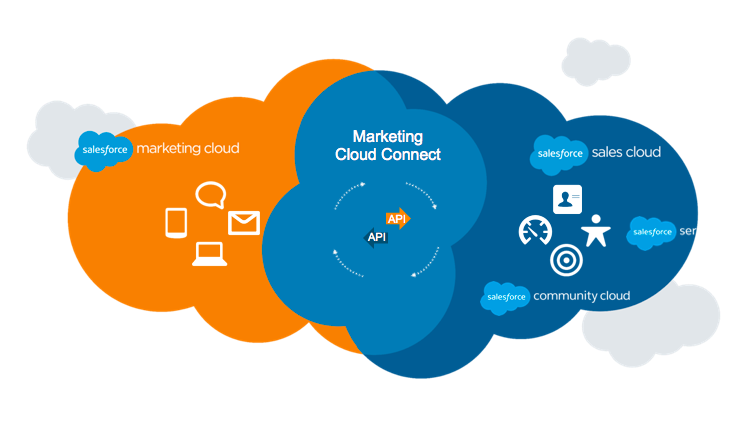
While they're separate products, Sales Cloud and Marketing Cloud are most powerful when connected. Here's how data flows between them:
Marketing → Sales
- Marketing Cloud nurtures leads with automated email campaigns
- When a lead reaches a scoring threshold, they sync to Sales Cloud as a qualified lead
- Marketing engagement history (emails opened, links clicked) appears on the Sales Cloud record
- Sales reps can see exactly how leads have interacted with marketing
Sales → Marketing
- Closed deals in Sales Cloud trigger customer onboarding journeys in Marketing Cloud
- Customer data from Sales Cloud segments marketing audiences
- Sales activity data enables marketing attribution and ROI reporting
Connecting Sales Cloud and Marketing Cloud requires the Marketing Cloud Connect integration. This is included with Marketing Cloud but requires configuration to sync data correctly.
Which One Do You Need?
You Need Sales Cloud If:
- You have a sales team that manages leads and opportunities
- You need pipeline visibility and forecasting
- You want a central system of record for customer data
- You need to track sales activities and performance
You Need Marketing Cloud If:
- You send high-volume email campaigns
- You need sophisticated customer journey automation
- You market across email, SMS, push, and advertising
- You need enterprise-grade email deliverability
You Need Both If:
- Marketing generates leads that sales closes
- You want unified reporting across marketing and sales
- You need to track ROI from marketing to closed revenue
- You want seamless handoff between marketing and sales
What About Other Options?
If you're a smaller organization, consider Salesforce Essentials (simplified CRM) or Pardot (B2B marketing automation that's natively built on Sales Cloud). These are often more cost-effective starting points.
Summary
Sales Cloud and Marketing Cloud serve different purposes for different teams, but they're designed to work together. Sales Cloud is your sales team's CRM for managing pipeline and closing deals. Marketing Cloud is your marketing team's platform for campaigns and customer journeys.
Most B2B organizations benefit from both, connected via Marketing Cloud Connect. The key is to implement them thoughtfully with clear data flows between marketing and sales.
Related Topics
Need Help with Salesforce?
Our MarTech-first approach at WegWorks (Weg Works) ensures your Salesforce implementation connects seamlessly with your entire marketing stack.
View Our Salesforce Services